

Lipedema and Heavy Legs: Symptoms, Massage & Lymphatic Drainage in Rotterdam

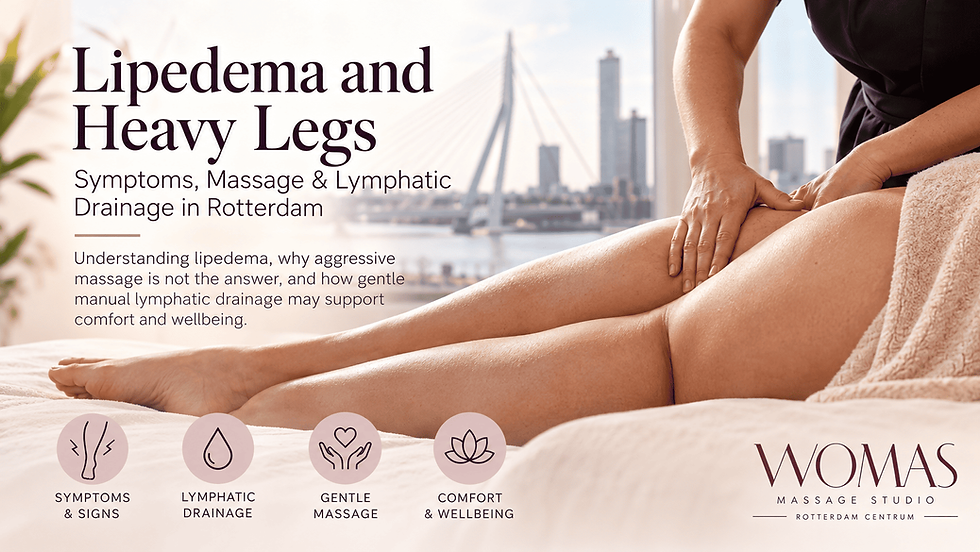
Understanding lipedema, why aggressive massage is not the answer, and how gentle manual lymphatic drainage may support comfort and wellbeing.
Do your legs often feel heavy, tender or painful to the touch? Do you bruise easily, or have you noticed that your legs seem disproportionately larger than the rest of your body?
Sometimes, these symptoms are attributed to ordinary fluid retention, weight gain or poor circulation.
However, in some people, they may be associated with a condition called lipedema — also spelled lipoedema in British English and lipoedeem in Dutch.
Lipedema is often misunderstood. Learning to recognise its characteristics is an important first step towards finding appropriate medical assessment and supportive care.
At WOMAS Massage Studio in Rotterdam Centrum, we believe that understanding your body is just as important as choosing the right massage.
What Is Lipedema?
Lipedema is a chronic condition characterised by a disproportionate accumulation of subcutaneous fat, most commonly in the hips, buttocks and legs. The arms may also be affected.
It occurs predominantly in women and often affects both sides of the body symmetrically.
Unlike ordinary weight gain, lipedema may cause significant tenderness, pain and changes in the texture of the tissue beneath the skin.
The exact cause is not fully understood. Genetic and hormonal factors are thought to play a role, and symptoms may first appear or become more noticeable around puberty, pregnancy or menopause.
Importantly, lipedema is not simply obesity or water retention. These conditions may coexist, but they are not the same.
7 Common Signs and Symptoms of Lipedema
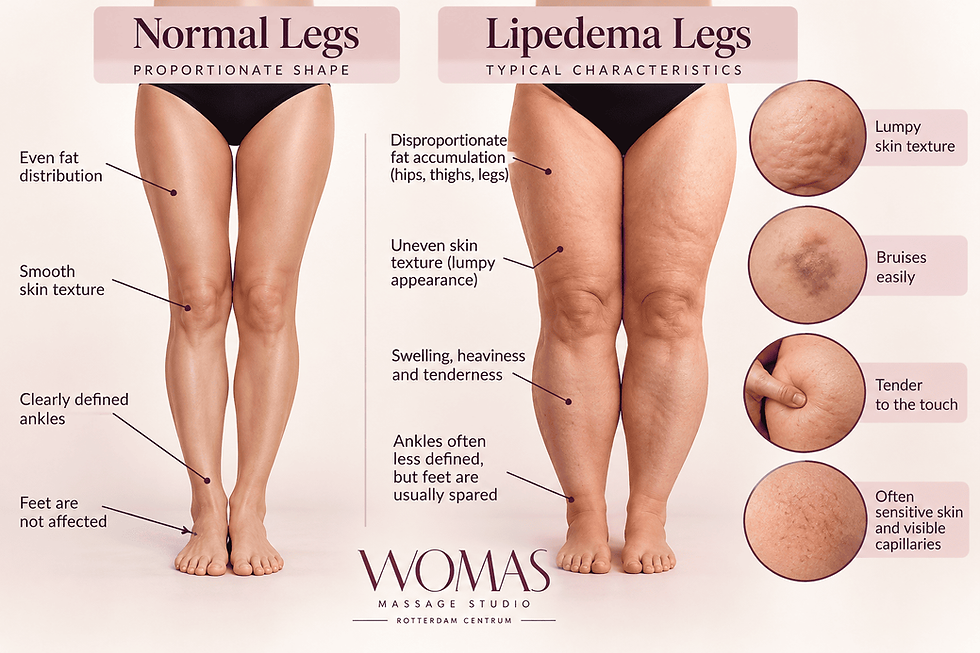
Lipedema affects individuals differently. Some people experience relatively mild symptoms, while others have substantial discomfort or difficulty with mobility.
Common characteristics include:
Disproportionate fat distribution: The legs, hips or buttocks may appear significantly larger than the upper body.
Pain and tenderness: The affected tissue may be sensitive, even to relatively light pressure.
Heavy or uncomfortable legs: Some people describe a persistent feeling of heaviness or tension.
Easy bruising: Bruises may develop more readily than expected.
Symmetrical involvement: Both legs are usually affected, although symptoms may not be identical.
Changes in tissue texture: The tissue beneath the skin may feel uneven, nodular or lumpy.
Feet usually remain unaffected: There may be a noticeable transition between the lower leg and the ankle or foot.
These symptoms do not automatically mean that someone has lipedema. Other conditions can produce similar complaints, and diagnosis requires a qualified healthcare professional.
Lipedema vs. Lymphedema: What Is the Difference?
Although their names sound similar, lipedema and lymphedema are different conditions.
Lipedema primarily involves abnormal fat distribution accompanied by symptoms such as tenderness and pain.
Lymphedema involves swelling caused by impaired lymphatic drainage and the accumulation of lymphatic fluid in tissues.
Lymphedema may affect the feet or hands, whereas these areas are usually spared in lipedema.
It is also possible for both conditions to coexist. When this happens, the term lipolymphedema may be used.
Because swelling can have several causes, it is important not to assume that every swollen or painful leg is affected by lipedema.
Can Aggressive Massage or Wood Therapy Break Down Lipedema Fat?
One of the most persistent myths in body treatments is that strong pressure can physically break down unwanted fat.
Lipedema fat cannot be eliminated by aggressive massage, deep pressure or wooden massage tools.
Maderotherapy, also known as wood therapy, uses specially designed wooden tools to massage different areas of the body.
However, there is no reliable scientific evidence that these tools can break down or remove the abnormal fat associated with lipedema.
For people with particularly tender or sensitive tissue, aggressive techniques may cause unnecessary pain, bruising or irritation.
This does not mean that every deeper manual technique is automatically inappropriate. The important considerations are the person's condition, tissue sensitivity, clinical circumstances and tolerance.
A treatment should never rely on the idea that pain or bruising proves that fat is being broken down.
More pressure does not necessarily mean a better treatment.
Lipedema Lymphatic Drainage Rotterdam: Can It Help?
Manual lymphatic drainage (MLD) is a specialised massage approach using gentle, controlled movements.
It is commonly used within lymphatic care and may be included in broader conservative management programmes for people with lipedema.
Some individuals report benefits such as:
A reduction in the sensation of heaviness.
Greater physical comfort.
Relief from certain swelling-related complaints.
Relaxation and improved tolerance of touch.
However, it is important to understand the limitations.
Manual lymphatic drainage does not remove lipedema fat, reverse the underlying condition or provide a cure.
Scientific evidence specifically supporting MLD as a standalone treatment for lipedema remains limited. Research has generally evaluated it alongside other approaches, such as compression, exercise and additional therapies.
For this reason, manual lymphatic drainage is best understood as a possible supportive option rather than a replacement for medical care.
Why a Personalised Approach Matters
Not everyone with heavy legs has lipedema, and not everyone with lipedema has the same symptoms.
Some people primarily experience tenderness. Others report heaviness, swelling or discomfort after long periods of standing or sitting.
The appropriate approach depends on the individual's symptoms, medical history and any diagnosed conditions.
For people with confirmed lipedema, healthcare professionals may recommend a combination of:
Individually selected compression garments.
Appropriate physical activity and movement.
Skin care.
Medical assessment and ongoing management.
Supportive manual techniques when suitable.
The goal is to improve comfort, mobility and quality of life — not to promise that massage can change the underlying fat disorder.
Perfect Legs at WOMAS Massage Studio Rotterdam
If you're searching for lipedema lymphatic drainage Rotterdam services, it's important to choose a gentle, personalised approach that respects the sensitivity of your legs. At WOMAS Massage Studio, we focus on comfort, relaxation and carefully selected manual techniques.
At WOMAS Massage Studio, Westblaak 92, Rotterdam Centrum, we offer Perfect Legs, a personalised manual leg massage treatment designed around comfort, relaxation and the individual needs of your legs.
Depending on your circumstances, the session may incorporate gentle manual lymphatic drainage techniques and other carefully selected manual approaches.
The treatment focuses on providing a comfortable experience for people who experience sensations such as heavy or tired legs.
When appropriate, gentle techniques may also be considered as supportive wellness care for people living with lipedema.
Perfect Legs is not a medical treatment for lipedema. It does not diagnose the condition, remove lipedema fat or replace care from a doctor, qualified lymphatic therapist or other healthcare professional.
If you have a medical diagnosis, significant swelling or unexplained leg pain, medical assessment may be necessary before booking a massage.
Looking for Manual Lymphatic Drainage in Rotterdam?
If you are searching for manual lymphatic drainage in Rotterdam, a massage for heavy legs or a personalised leg treatment, you can explore the options available at WOMAS.
📍 WOMAS Massage StudioWestblaak 92, Rotterdam Centrum, Netherlands
Discover Perfect Legs and book online at www.mywomas.com.
Frequently Asked Questions About Lipedema and Lymphatic Drainage
Can lymphatic drainage reduce lipedema fat?

Copiar ALT
No. Manual lymphatic drainage does not remove the abnormal fat tissue associated with lipedema. It may be considered for symptom support in certain circumstances.
Is lipedema the same as fluid retention?
No. Lipedema is primarily a disorder involving disproportionate fat tissue. Fluid retention may occur alongside it, but is not the defining characteristic.
Is deep tissue massage safe for lipedema?
It depends on the individual and the technique. Sensitive tissue may not tolerate strong pressure well. Deeper techniques are not universally prohibited, but they should be carefully selected and should not cause unnecessary pain or bruising.
Can maderotherapy cure lipedema?
No. There is no reliable evidence that maderotherapy can cure lipedema or break down its characteristic fat tissue.
How often should someone with lipedema receive lymphatic drainage?
There is no universal schedule. The suitability and frequency of treatment depend on individual symptoms, other medical conditions and the wider care plan. A qualified healthcare professional can advise on clinical management.
Where can I find manual lymphatic drainage in Rotterdam Centrum?
WOMAS Massage Studio, located at Westblaak 92 in Rotterdam Centrum, offers personalised manual lymphatic drainage and leg massage services for comfort and wellbeing. These services are not a substitute for specialist medical treatment.
Final Thoughts: Understanding Your Legs Matters
Living with heavy, sensitive or painful legs can affect everyday comfort and confidence.
Recognising the possible signs of lipedema is important, but so is avoiding unrealistic treatment promises.
No massage can simply break down lipedema fat. Supportive care should focus on the individual, respect tissue sensitivity and work alongside appropriate medical guidance.
At WOMAS, our philosophy is simple: personalised manual care, thoughtful techniques and respect for your body.
Explore Perfect Legs at www.mywomas.com.
Medical Disclaimer
This article is intended for general education and awareness. It does not provide a medical diagnosis or replace professional medical advice.
Not all symptoms described are specific to lipedema. If you suspect lipedema, experience unexplained swelling or have persistent leg pain, consult a qualified healthcare professional.
Sudden swelling or pain in one leg requires prompt medical assessment, particularly if accompanied by warmth or redness. Chest pain or sudden shortness of breath requires emergency medical attention.


Comments